
The Constitution Isn’t Hanging By a Thread — Yet
The Saints are comfortably unprepared for what's actually coming. Here's the real meaning of Joseph Smith's prophecy.


We have lulled ourselves into a false sense of security by turning “hanging by a thread” into a colloquialism.
Here’s the mistake, plainly: we’ve taken one fraction of a prophecy and stretched it to cover every constitutional skirmish, every bad ruling, every election that goes the wrong way. A headline drops — a Supreme Court decision, a federal mandate, a vote that breaks against us — and someone in the room says it. Maybe it’s a brother in Elders Quorum. Maybe it’s you, on the couch, phone in hand. “The Constitution is definitely hanging by a thread, now.”
Don’t misread me. The concern underneath it is good. Asking does the Constitution still mean anything? — asking how do we get back to its real limits and protections? — that watchfulness is exactly what covenant men should feel. Keep it.
But somewhere along the way we made a serious mistake. We took a prophecy and turned a sliver of it into a slogan. And in so doing, we lost the context that tells us what’s coming and who we’re supposed to become before it does. In a real way, this casual use of “hanging by a thread” is keeping us blind, comfortable, and unprepared for the very assignment the Prophet said would fall on us.
Because the prophets were not describing a rough political season. They were describing something far bigger, far later, and far more demanding. And once you see what they actually said, the assignment for Latter-day Saint men changes completely.
First, the part we skip: the nation is in ruins
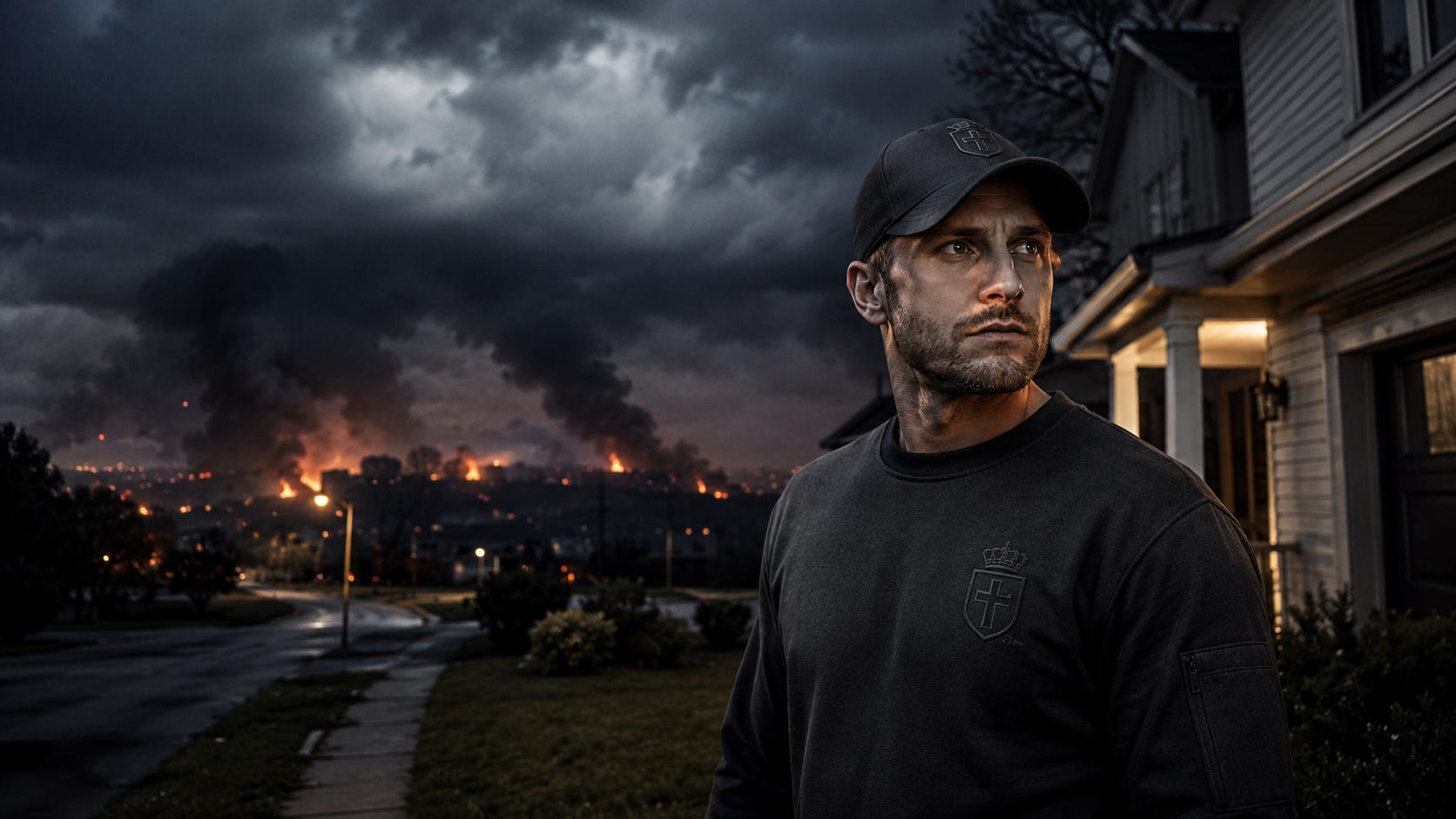
Start with where the phrase even comes from, because most of us are quoting a paraphrase of a paraphrase.
On July 19, 1840, in Nauvoo, the Prophet Joseph Smith preached on the redemption of Zion. According to contemporary records, he said:
“Even this nation will be on the very verge of crumbling to pieces and tumbling to the ground, and when the Constitution is upon the brink of ruin, this people will be the staff upon which the nation shall lean, and they shall bear the Constitution away from the very verge of destruction.”
— Nauvoo, July 19, 1840, discourse on Doctrine and Covenants 101
And here is the more familiar version, the one with the thread reference, as recorded by Brigham Young:
“Will the Constitution be destroyed? No: it will be held inviolate by this people; and, as Joseph Smith said, ‘The time will come when the destiny of the nation will hang upon a single thread. At that critical juncture, this people will step forth and save it from the threatened destruction.’”
— Journal of Discourses 7:15
Now read the words we leave on the cutting-room floor. Crumbling to pieces. Tumbling to the ground. The very verge of destruction. A critical juncture. Threatened destruction.
This is not a country with bad policies and worse politicians. This is a country at the edge of being gone — and the covenant members stepping in to carry off what’s left. The saving and the ruin are in the same sentence. You cannot claim the rescue without admitting the ruin has already come. Our slang has quietly deleted the ruin and kept the rescue. We skipped to the last page and called it the headline.
The ruin comes first. The prophets could not have been clearer.
We are closer to it than we think

Before we look at what that ruin will feel like, look at what causes it — because once you see it, you can’t ignore it.
Ask a faithful Latter-day Saint what brings the nation down, and you’ll hear good answers: pride, secret combinations, Gadianton robbers. All true. But Brigham Young named a mechanism that is more ordinary, and far more frightening, because it’s happening:
“The nations will consume each other, and the Lord will suffer them to bring it about... You see it rife in communities, in meetings, in neighbourhoods, and in cities. That is the knife that will cut down this Government.”
— Journal of Discourses 8:143
He doesn’t point to a foreign army. He doesn’t point at one tyrant in one office. He points at us — at the grinding friction of a people who have lost the ability to live beside one another. The secret combinations and the pride matter, but even in Lachoneus’ time (see 3 Nephi 3–4) we see those challenges can be weathered if the people come together. Rather, it is the collapse of basic civility between neighbors that drives in the blade and severs the life from the tree.
A Springfield lawyer saw the same thing almost two hundred years ago. In 1838, Abraham Lincoln stood before a room of young men and warned them where the real danger lay:
“If destruction be our lot, we must ourselves be its author and finisher. As a nation of freemen, we must live through all time, or die by suicide.”
— Lyceum Address, Springfield, Illinois, January 27, 1838
Suicide. Not invasion. Self-inflicted.
So look at the last few years honestly. Town-hall meetings dissolving into shouting matches. Parents arrested at school-board meetings. Neighbors who can’t be in the same room. Families that no longer gather for the holidays. Friendships severed over a yard sign or social media comment. We keep telling ourselves it’s just the weather — a bad season that’ll pass when the pendulum swings back.
Deep down we know better. The knife is out of the sheath and already cutting.
A divided Congress is not the prophecy. A contested election is not the prophecy. A ruling that guts a freedom we cherish is not the prophecy. Those are real, and worth fighting for — but they are not the threadbare day. The threadbare day is the absence of the government altogether, and a level of bloodshed Joseph did not soften for his listeners. I won’t soften it for you either.
What that day actually looks like
You know the nation will crumble. The harder question is what that looks like up close — and the prophets did not leave us guessing.
“Mobs will not decrease, but will increase until the whole government becomes a mob, and eventually it will be State against State, city against city, neighborhood against neighborhood... and those who will not take up the sword against their neighbors, must flee to Zion.”
— Brigham Young, Journal of Discourses 20:151
Follow the descent in a single sentence: mobs, then the whole government becoming a mob, then state against state, then — neighborhood against neighborhood. It narrows until it reaches your block, your ward boundaries, your street.
Notice where the violence drives people: to Zion. It will be so terrible that men run there for their lives (see Doctrine and Covenants 45:68). And the Saints who delay going will wish they hadn’t.
Joseph Smith painted a terrible scene he saw in a vision to several of the apostles in 1839:
“I saw men hunting the lives of their own sons, and brother murdering brother, women killing their own daughters, and daughters seeking the lives of their mothers. I saw armies arrayed against armies. I saw blood, desolation, fires... These things are at our doors. They will follow the Saints of God from city to city.”
— History of the Church 3:390–391
Blood.
Desolation.
Fires.
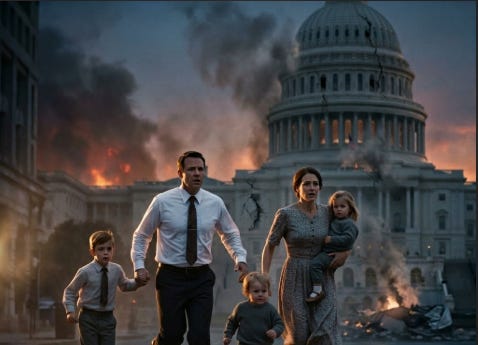
This is not a metaphor for partisanship. This is a nation devouring itself down to the level of the family. And read the line we always skip: it “follows the Saints from city to city.” The only refuge named anywhere in these prophecies is Zion — the gathered body of the Saints in the Rocky Mountains.
That should stop every one of us cold. Because if the prophecy is real, the men in the most danger of being caught flat-footed are the ones still grading the political weather while the storm builds overhead.
Now watch when the Constitution gets saved
Put the rescue back into the story to understand the timing. Saving the Constitution turns out to be an act of survival, the only way to hold a remnant together when everything else has failed.
Orson Pratt, preaching in 1875, after America had already bled through the Civil War:
“[God] will speedily fulfil the prophecy in relation to the overthrow of this nation... We shall be obliged to have a government to preserve ourselves in unity and peace; for they, through being wasted away, will not have power to govern; for state will be divided against state, city against city, town against town, and the whole country will be in terror and confusion... When that time shall arrive, we shall necessarily want to carry out the principles of our great constitution.”
— Deseret Evening News, October 2, 1875
Read the order of operations in his own words. First the nation is “wasted away” until it “will not have power to govern.” Then — “when that time shall arrive” — the Saints take up the principles of the Constitution. Not before. Not as a campaign. Not as a midterm strategy or a new political party. As the only people left standing who can. The Constitution is magnified by a people already gathered, already united, after the old order has collapsed entirely.
George Q. Cannon made the destiny explicit:
“...the Latter-day Saints will be the people to maintain constitutional government on this land... the day will come among the wicked, that every man that will not take his sword against his neighbor, must needs flee unto Zion for safety... men will be compelled to flee to the ‘Mormons,’ despised as they are now.”
— Journal of Discourses 18:10
There it is — the whole assignment, hiding in four words: flee to the Mormons. Let that sink in. You cannot flee to a people who aren’t ready to be fled to.
We’ve been lulled to sleep
Here’s the uncomfortable part, and I’m aiming it carefully — not at you, but at the habit so many of us have slipped into.
There’s a place for the phrase. Locally, “the Constitution hanging by a thread” can light a fire under us to defend something sacred, and faithful leaders at every level have used it that way for good reason. The document is inspired, and it is under pressure now. That’s fine.
But it’s time we get real about what is actually coming — and about the kind of man it will take to meet it. The prophets and apostles described a day you have to be ready for long before it arrives. And what’s more, John Taylor, George Q. Cannon, Eliza R. Snow, Brigham Young, and others all named who would do the saving: the Elders of Israel.
Not a future generation of stronger men. Not someone better prepared who will surely show up.
Us.
The time will come when the government of these United States will be so nearly overthrown through its corruption, that the Constitution will hang as it were by a single hair, and the Latter-day Saints — the Elders of Israel — will step forward to its rescue and save it.
Eliza R. Snow, recounting the Prophet Joseph Smith, Ogden, Utah, 1871
The real assignment
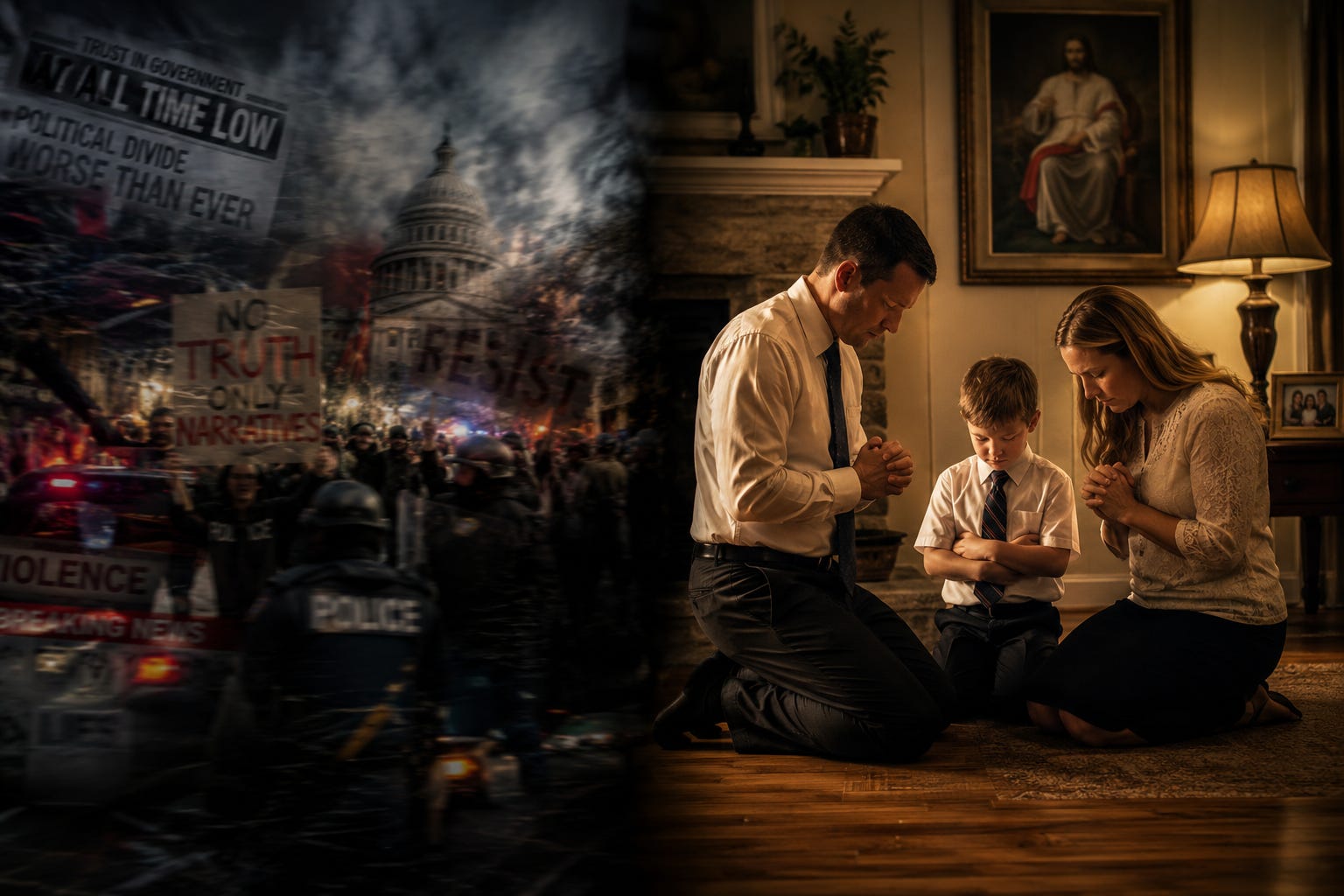
So the question for the Saints — and for the men especially — is not “which party, which candidate, which ruling?” It’s harder, and far better:
Would they flee to me?
If the country were wasted away tomorrow — the government a mob or gone, the neighborhoods at war — would my home, my family, my ward be the refuge the prophets described? Would the frightened and the desperate find at my door a man with faith enough to lead, provisions enough to share, and steadiness enough to be trusted? Or would they find a man who was casual about preparation and merely a keyboard warrior on the internet?
That’s the gap. Closing it isn’t abstract. It comes down to four things, and not one of them is optional.
First — be valiant, now, in private and in public. Not outrage from behind a screen. Visible, costly faithfulness in the real rooms of your real life: the ward council, the workplace, the school board, the dinner table. Standing for faith, family, and the principles of liberty is a muscle. A muscle never worked under load will not appear on the worst day of the nation’s life. Build it now, while it only costs a little, so it’s there when it costs everything.
Second — increase in faith, for real. Not sentiment, not nostalgia, not a tidy testimony you can recite. The actual capacity to receive revelation, to lead a family by the Spirit, to stay centered in Christ when all hell breaks loose. Real study, real prayer, real repentance you model in front of your children, real obedience that makes you a man the Lord can move through.
Third — prepare physically, not only spiritually. The prophets did not describe a symbolic flight to a symbolic Zion. They described literal ruin, literal hunger, a literal need for people who can sustain others. Food storage. Practical skills. Some measure of self-reliance, the means to provide and protect. I’m not talking fringe survivalism — it’s the very thing the Church has counseled for generations. Spiritual readiness without physical readiness is half an answer to a prophecy given in full and the equivalent of faith without works. If people will be compelled to flee to the Mormons, then we had better be ready to receive them and protect against the dangers they are fleeing.
Fourth — increase in knowledge. How do you save a Constitution you’ve never read? How do you live its principles as the antidote to chaos if you can’t name them? The Elders who carry it off the verge of destruction will be men who actually know what’s on the page — and why it was inspired. Learn it now, on purpose, so you can magnify it later when everything is on the line.
Before the thread snaps
The thread is real. The day is real and we are hurtling toward it fast. We should make the wisest use of our time, every single day, to become valiant where it counts. Time to build the faith. Time to lay up the stores, learn the skills, and become the people others will one day run to.
There is no room whatsoever for delay.
So, let’s be honest and view our efforts to uphold and renew the Constitution today as merely “buying time” and stop reading the prophecy backward. Let’s start preparing for the dangerous but necessary rescue to come.
That is the prophecy. That is the assignment. And that is the kind of man the Lord has been waiting for all along.
These four are simply Preside, Provide, and Protect — brought to life and aimed at the day the prophets saw coming. That is the whole reason Send Me exists: to help the Elders of Israel become these men before the moment demands it. If this is your fight too, stand with us — join or support the work at sendmesaints.org.
Sources
Joseph Smith, Nauvoo discourse on the redemption of Zion, July 19, 1840 — Joseph Smith Foundation
Brigham Young, Journal of Discourses 8:143 — journalofdiscourses.com, Vol. 8
Brigham Young, Journal of Discourses 20:151 — journalofdiscourses.com, Vol. 20
Abraham Lincoln, Lyceum Address, Springfield, Illinois, January 27, 1838
Joseph Smith, History of the Church 3:390–391
Orson Pratt, Deseret Evening News, October 2, 1875
George Q. Cannon, Journal of Discourses 18:10 — journalofdiscourses.com, Vol. 18
Joseph Smith and the United States Constitution — BYU Religious Studies Center
Great Post and Account Alexander 👍🏼🙏👍🏼🙏👍🏼
I believe this is where living the law of consecration comes in. One of the laws we covenant with the Lord. If we can live that I'm sure it will hasten thw time for the Savior to come because He is waiting on us.