
The Jordan Peterson Message Failed - Now What?
What his collapse reveals about the Latter-day Saint men sitting in your elders quorum — and the brotherhood we quietly stopped building.

A few weeks ago the Church’s own account shared the story of a young man who grew up around the Relief Society sisters who taught him to sew, trained as a ballet dancer, and now designs women’s fashion in New York. Good for him — keeping the faith in a hard place is no small thing. [1]
One widely shared X post responded to it as a little skit: [2]
Men in the Church: “…Do you have anything for us?”
Church PR Dept: “Oh for sure! Yeah, here’s a story of a man. You’ll love this! “He attended Relief Society activities as a boy, dances ballet, and now he’s a women’s fashion designer in New York City. He wants to share his testimony about ‘finding identity through clothing’ and the ‘power in femininity.’”
Men: “Ah, okay. That’s... that’s cool…But do you have anything that will inspire the other 99% of us? Like a guy holding down a tough job to make ends meet? A guy who sacrifices so his kids can have a better future? …No? Nothing? Okay...”
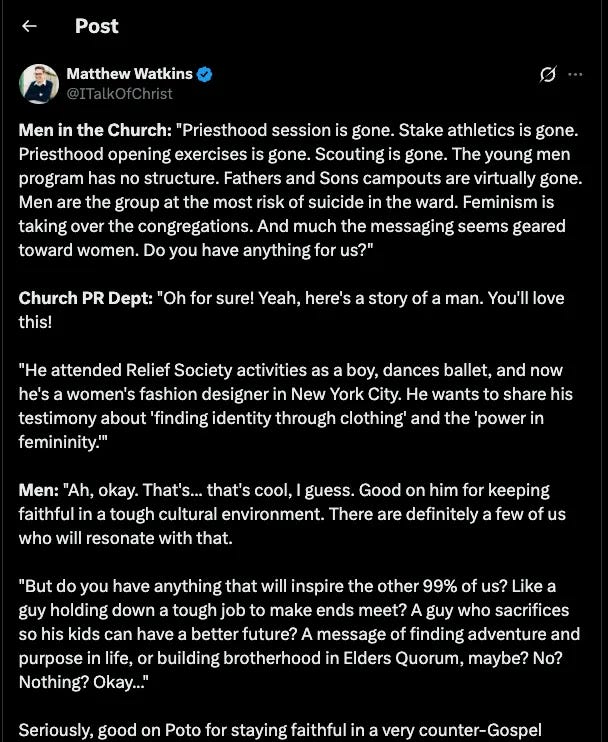
The replies to his post reveal the same ache over and over.
He isn’t the only one. Not long before, the Church’s account held up a young husband describing his own path this way: “Some days I still feel like I’m figuring it out” — and framed that drifting as sacred. [3] I wish that man well, but his story is really a symptom — one more sign of the floundering so many LDS men feel today.
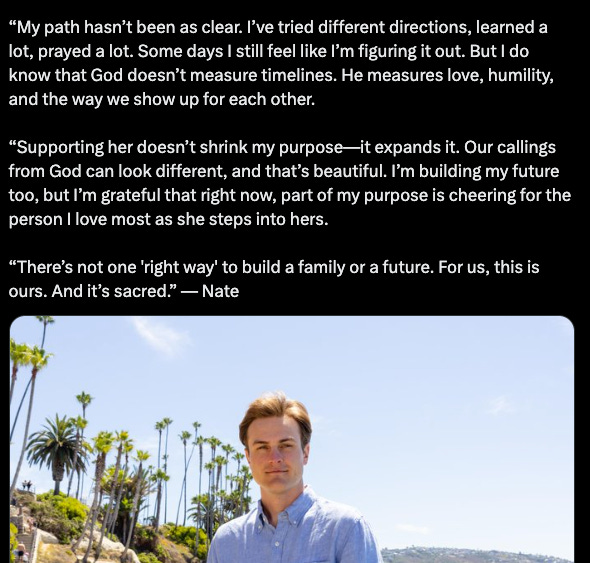
That ache is the real story. Our men are not starving for entertainment. They are starving in two ways. First, to be seen — to hear someone in their own house of faith speak to their manhood and their struggles. Second: to have someone or something point them to the path of duty; calling them to bear real burdens of responsibility, and telling them what they are for and that it’s worth it.
This ache, this hunger gave rise to an international figure that would eventually fail himself.
Built to Carry Something Heavy
Men are so hungry for direction and a voice that a generation of them made a Canadian psychology professor their mentor, their voice.
Jordan Peterson did not become a phenomenon by accident. He became one because he took seriously the thing almost no one else would name: that modern men feel purposeless and unanchored, handed no clear role and no rite of passage, and told to take up less space or stay out of the way. He looked men dead in the eye and told them to stand up straight. Carry something heavy. Clean their room. Tell the truth, even against terrible cost and tyrants. Become someone a future family and world could actually lean on.
That message was true, and it struck a major chord. The young men who traveled hundreds, sometimes thousands of miles to hear him were not fools chasing a fad. They were reaching for something real that the world had stopped offering them: purpose through responsibility, meaning through strife, and permission to live with masculine strength. They were right to reach.
Should we be shocked to learn that LDS men are feeling the same way, and reaching out too?
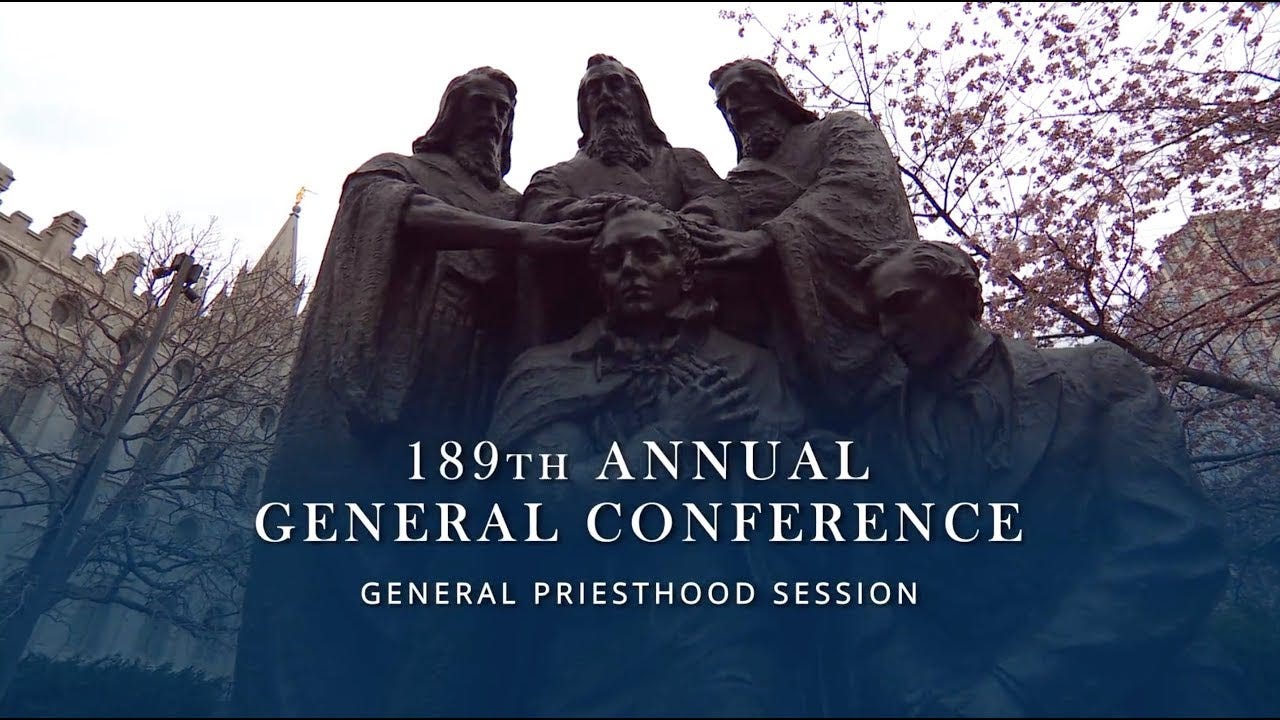
Not long ago the men of the Church had an hour built into general conference twice a year just for them. In those sessions the Lord’s prophets stood toe-to-toe with us — to call us out, to encourage us, to speak to us the way men and boys need to be spoken to, long to be spoken to. It was fuel and a model of priestly masculinity that kept the spark alive in elders quorums worldwide. Then, in 2018, it moved to once a year; by 2021 the separate session was folded away. [4] I don’t second-guess the decision — the Lord giveth and taketh away. But I won’t pretend that many of us don’t miss it. Since then, a feeling has crept into a good many elders: the quorum isn’t the strength or the brotherhood I need it to be.
The younger men feel the gap even earlier. So much of the masculine, responsibility-driven demand — the rites of passage that used to prepare a boy for manhood — has thinned out. The rigorous father-and-son campouts that grounded him. The merit badges and week-long treks, (usually through Scouting) that gave him competence, and a taste of real accomplishment. Strip those away and is it any wonder our young men arrive at manhood short on confidence, direction, and purpose? Is it any wonder many turn away from serving a mission?
The hunger Peterson fed is the same hunger the priesthood quorums used to fill. When our own voice went quiet, his got louder.
And Then the Strongest Voice Fell

The man who told millions to find heavy burdens and bear them collapsed under his own.
Peterson had already been prescribed a benzodiazepine to fight the stress and anxiety of a punishing work schedule. Then, in the spring of 2019, as his wife Tammy fought kidney cancer, his doctors raised the dose to manage this new level of strain. The dependence that followed spiraled into a medical crisis no Western clinic could pull him out of. By January 2020 he was in a hospital in Moscow, in a medically induced coma for nine days, his breathing run by a machine. The most articulate voice on masculine responsibility had been carried to the edge of his own life. [5]
So what went wrong? Was he wrong?
Peterson had everything from a worldly viewpoint. Fame. A platform reaching millions. More raw intellect than most of us will ever hope to gain a fraction of. When the Substack writer Paul Robson went back through Peterson’s own interviews — including a long conversation with Jonathan Pageau — he found Peterson admitting that beyond his immediate family, he had almost no real fellowship. Fans by the millions. Brothers, none. [6]
So when the one relationship carrying all his weight — his marriage — became the very source of the crisis, there was no one underneath him to carry him. No quorum of men who knew his name and his struggle. No brother to lean on. He had told everyone else how to stand, and when he fell, the room was empty.
He fell victim to the very weakness of his own message: he had the purpose right, yet no brotherhood to bear him up.
The Second Half of the Equation
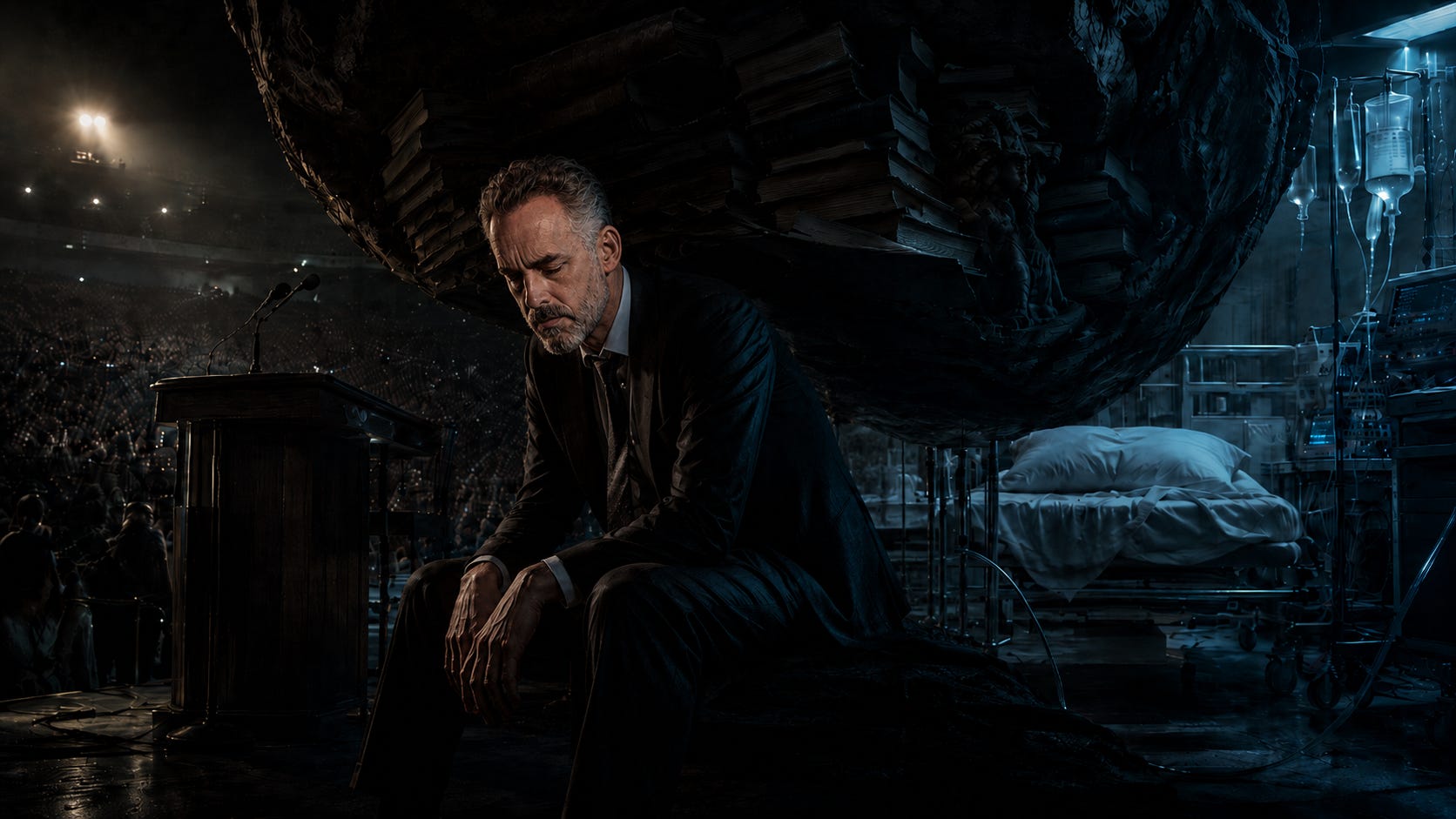
Do not mistake this for a takedown. Jordan Peterson was right about the burden, about the responsibility, about men being built to carry something heavy — to find purpose in responsibility and meaning in the hard thing.
But there is a second half to the equation, and missing it left him dangerously exposed: no man carries the heaviest burden alone and survives it. Strength without brotherhood doesn’t make a man invincible, or even adequate for the deepest valleys. It makes him a Peterson — magnificent, and yet one bad season away from crashing to the floor.
Look at what Alma taught at the waters of Mormon. He did not gather his people and tell them to set their burdens down nor did he tell them to keep bearing burdens all by their lonesome. He told them to keep carrying — and to carry one another’s, too:
“...and are willing to bear one another’s burdens, that they may be light... and comfort those that stand in need of comfort.” — Mosiah 18:8–9 [7]
Notice what does not change in that verse. The load stays. The mission to do the hard thing stays. What changes is that no man is under his load alone. Bearing one another’s burdens is not the alternative to shouldering the heavy thing — it is the only way men (and women) shoulder it without being crushed. Peterson handed men the weight and forgot to give them each other.
This is what the world keeps getting wrong, and it is costing us our best men: a voice can call a man to rise. It cannot carry him when he falls. Peterson could hand a man a vision through a screen — and that vision was often good and true. But the day your own burden grows too heavy, the podcast cannot reach over and take one end of it. The Savior can, and He works through us to be the brother in the same room to help you bear that burden.
The Quorum That Became a Meeting
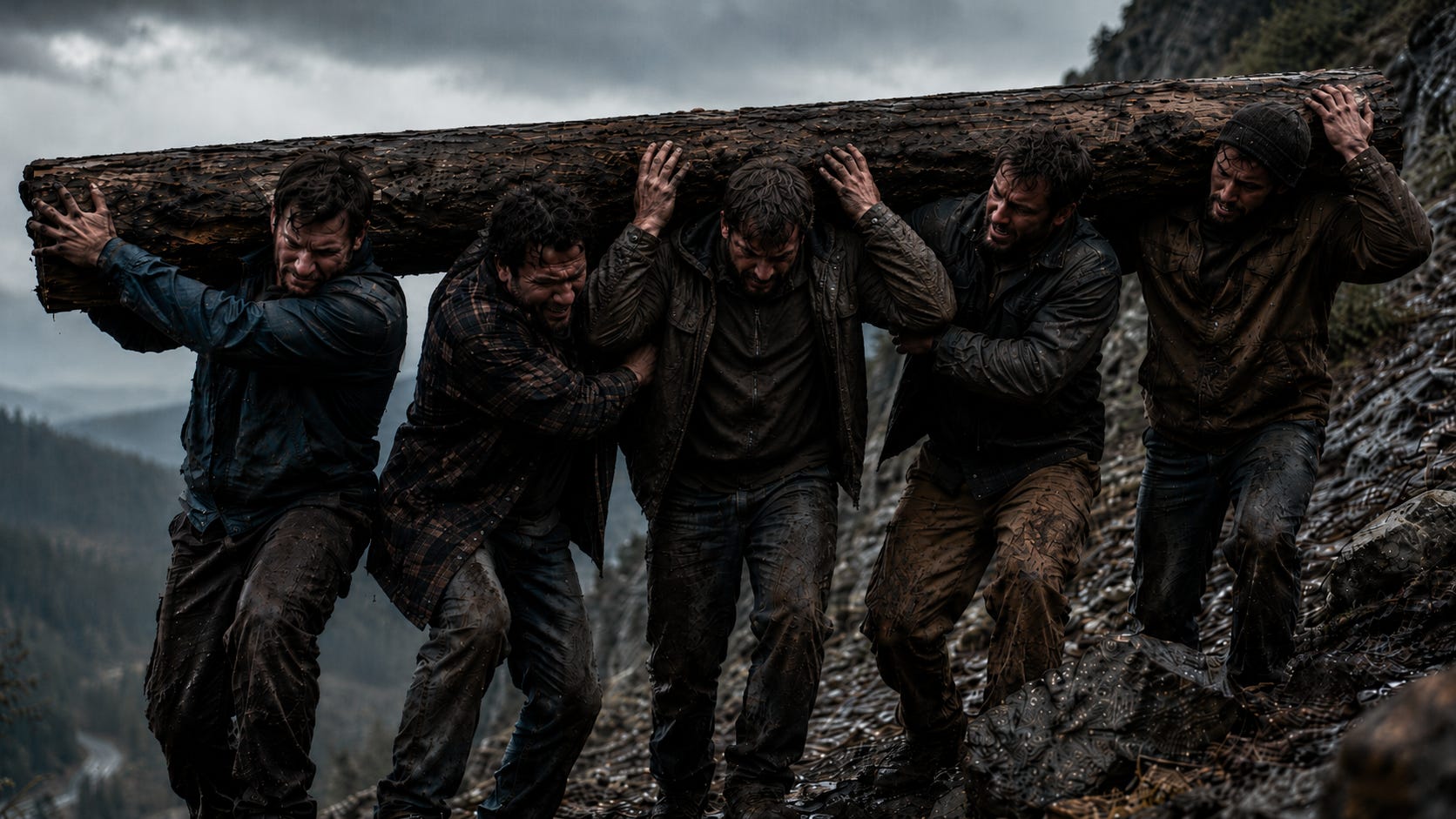
Here is where it lands closest to home, because we cannot only point at Peterson or a social media account. For a lot of our men, the brotherhood that is supposed to be built into the priesthood no longer feels like one. The elders quorum has quietly become a meeting you attend, not a brotherhood you belong to — a lesson, a sign-up sheet, a room full of good men who don’t actually know each other and bear each other’s burdens.
And the men are paying for it, in numbers most of us have never seen. The share of American men with at least six close friends has fallen from 55 percent in 1990 to just 27 percent. The share with no close friends at all has jumped fivefold, from 3 percent to 15 percent. Among unmarried men who aren’t dating, one in five report not a single close friend. [8] These are not lonely misfits at the margins. These are the men next to you in the pew — the ones saying I’m fine on Sunday and going home with that overwhelmed or lost feeling on their hearts.
For many congregations around the country, we did to the quorum what Peterson’s platform did to him. We turned a brotherhood into a broadcast. We show up, we receive, we go home — an audience, not a band of brothers with shared purpose and burden.
What You Were Already Given
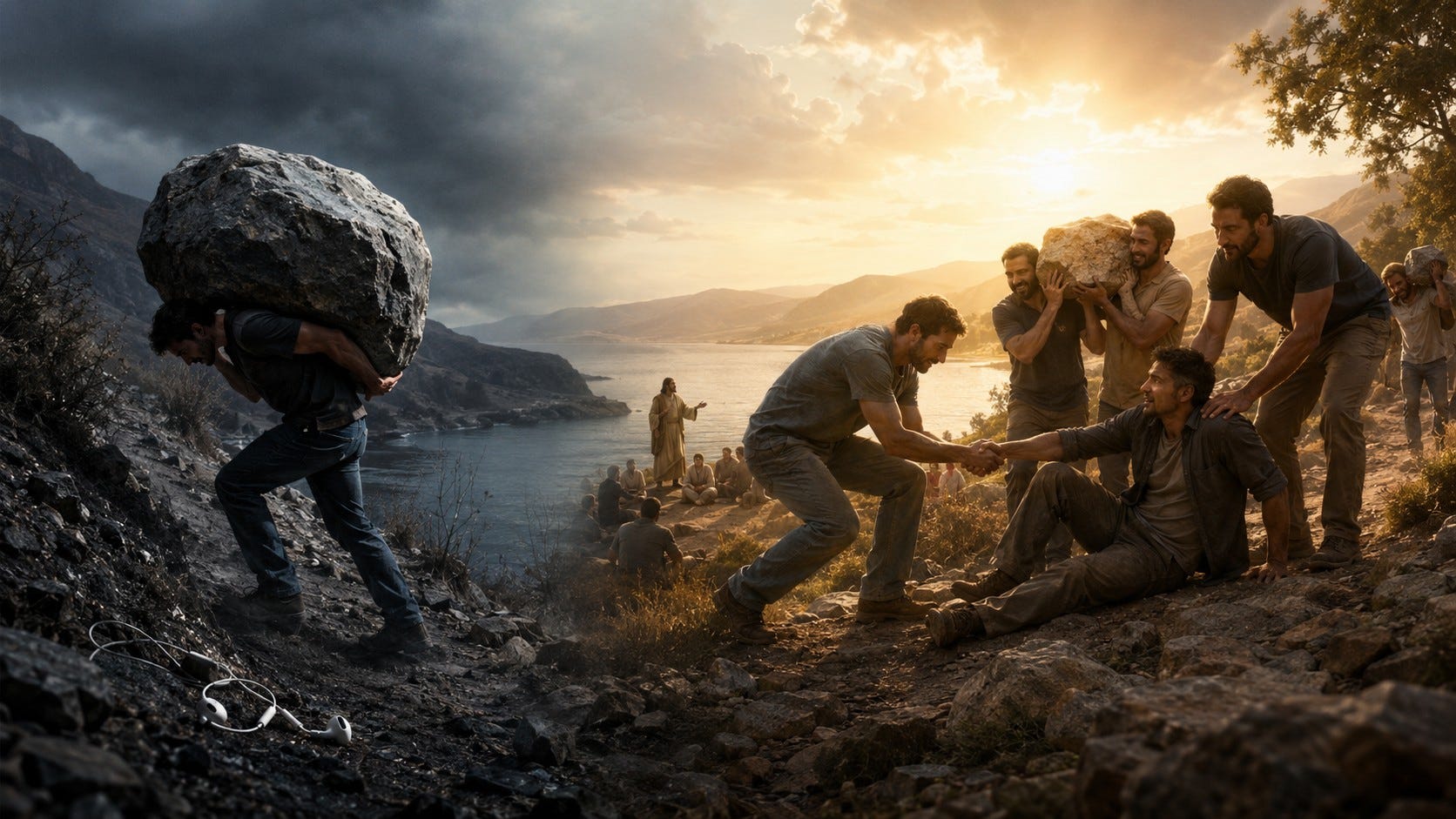
Here is the good news.
Peterson had to build a following. You were placed inside a quorum — a body of men set around you, by covenant, with an actual obligation to you and you to them. He had fans who consumed him. You have brethren who are bound to you. The most influential masculine voice of our day was brought to the edge of death for want of the exact thing that is already available through the church.
The structure is already yours, and it becomes a true brotherhood the moment a few men decide to make it one. And that decision is smaller and more doable than you think.
It looks like this. This week, speak to or text one man in your quorum — not about an assignment, just to grab breakfast and actually ask how he’s doing. The next time a brother asks how you are, tell him one true thing instead of “fine.” Find the man everyone can see is struggling and carry something real for him: an afternoon with his kids, a Saturday helping him move, a standing Sunday-night call he can count on. None of that takes a new program, a budget, or permission. The men you would need are already in the pew. The only thing missing is a few brothers who decide that it’s no longer ok to keep things the same and take their quorum to a level deeper.
Here is the truth underneath all of it: the problem was never really the Church’s social media, or the folded priesthood session, or the campouts that vanished.
The General Priesthood Sessions, the rigorous activities, were good in their day, but were never meant to be the source of our strength. That source was always supposed to be men who bear one another’s burdens. We were always meant to carry on the spirit of brotherhood and activity. Peterson told men to shoulder the weight of responsibility; it is time we carried that same conviction straight into our own wards and became the brotherhood we keep waiting for someone else to build.
If you’re ready to stop carrying it alone — to find the brothers who will actually know you and hold the load with you — come find them at sendmesaints.org.
Not a following. Not an audience. A brotherhood.
“...and are willing to bear one another’s burdens, that they may be light.” — Mosiah 18:8
Sources
[1] The Church of Jesus Christ of Latter-day Saints, official social post profiling the young Latter-day Saint fashion designer (2026). [Canonical link still needed — please supply.]
[2] @italkofchrist, viral response to the Church’s post, X, 2026. Read on X
[3] The Church of Jesus Christ of Latter-day Saints, official social post featuring the young husband “still figuring it out,” X, 2026. Read on X (Confirm link is live before publishing.)
[4] “First Presidency Announces Changes to General Conference, Including Discontinuing Saturday Evening Session.” Church News, June 7, 2021. Read on TheChurchNews.com
[5] Jordan Peterson’s 2019–2020 health crisis — benzodiazepine dependence amid his wife Tammy’s kidney-cancer diagnosis, and the nine-day medically induced coma in Moscow (January 2020). Read on CBC.ca; Read on NewRepublic.com; Read on Wikipedia
[6] Robson, Paul. “The Fall of the Prophet.” The Path of Manliness, June 4, 2025. (Peterson’s admission of having almost no fellowship outside his immediate family, drawn from his interview with Jonathan Pageau.) Read on Substack
[7] Mosiah 18:8–9, The Book of Mormon. Read on ChurchofJesusChrist.org
[8] Cox, Daniel A. “American Men Suffer a Friendship Recession.” Survey Center on American Life, 2021. Read at AmericanSurveyCenter.org
The lack of brotherhood is such a big problem. I need to learn more about Send Me. This challenge is one of the reasons I started Love Your Actual Neighbor.
Our quorum recently started a weekly lunch gathering for guys who work from home. We get together at someone’s home and chat for an hour. It’s been great for those of us who show up. But it’s a challenge to expand it.
I think another big problem is that many men don’t know that they need friendship and brotherhood. They think being alone is part of life or that they need to be so devoted to their families that they don’t have time for friendships. That is the first big problem I run into repeatedly in my work.
Great Post...my EQ is struggling and I 🙏 this adds a Little SPARK to our Discussions 👍🏼🙏 Thank You