
The Most Fatal Feeling
What's actually happening to our LDS single men — and the doctrine that calls them back.


Our LDS men have stopped feeling needed. Thousands of them are wandering, without a path.
Richard Reeves — a Brookings-trained scholar who runs the American Institute for Boys and Men, with no known LDS leanings — said it plainly on the record this year:
“Feeling unneeded is probably the most tragic feeling that anybody can feel, and probably the most fatal.” [1]
He paired that statement with a devastating toll: the Centers for Disease Control and Prevention reports 38,977 American men were lost to suicide in 2023 — males account for roughly four out of every five suicides in the United States while making up half the population. [2]
The American Family Survey 2025 — a joint project of the Wheatley Institute, BYU’s Center for the Study of Elections and Democracy, and Deseret News — surveyed 3,000 Americans last August and found similar findings, stating:
“A growing number of men are reporting feeling aimless and isolated.” [3]
This feeling of being unneeded and aimless continues to grow the longer we have tried to change men and reduce their importance. The cultural pressure on our young men is loud and getting louder: be less masculine, take up less space, and if you hope to matter at all, stand out in unreasonable ways — earn way more, get a demigod body, build more, brand more. Underneath the noise, the quieter question keeps surfacing in those quiet moments:
Am I actually needed?
Not as a paycheck. Not as the brother who sets up the chairs. Needed — in the irreplaceable way the Lord built into a man’s role itself.
The honest answer, doctrinally, is yes. And we have spent twenty years quietly burying the words that would let our young men know they’re needed. Consider that, addition to the figure of male suicides, is the unspoken number of families going unstarted because the man never found his path there.
They Are Still Seeking A Path to Manhood & Purpose
For most of the last century, the path a young Latter-day Saint man walked to manhood was visible and well-marked. The secular world handed him a ladder: get an education, build an income, demonstrate steady provision, then ask. It was reductive at its best. But the rungs were visible. He could climb them. The Church had its own rungs as well — obtain the two priesthoods, serve a mission, go to the temple, find a worthy woman and marry her there, have kids.
Now the ladder seems gone. As Deseret News reported in 2024, even the Church Educational System has called dating on its campuses “an endangered species” — the traditional Latter-day Saint pathway to a temple sealing is on life support by the Church’s own admission. [4]
Let’s look at the secular rungs first. A November 2024 analysis from Pew Research Center using U.S. Census data found that 47% of women ages 25 to 34 now hold a bachelor’s degree compared with 37% of men — a ten-point gap that did not exist in 1995. [5] This gap starts to point to a real problem captured by the American Family Survey 2025, in which researcher Jeremy Pope identified what he called the “performance component” of the marriage gap:
“Women look at men and wonder if they’re bringing enough to the table to make marriage enticing.” [3]
Perhaps that statement sounds harsh to claim, but the reality is that women historically tend to marry men whose income-earning potential matches or exceeds their own. A 2024 analysis from the Institute for Family Studies, drawing on Census data, confirms it is still that way: 63% of newly married young women in 2023 were still out-earned by their husbands. [6]
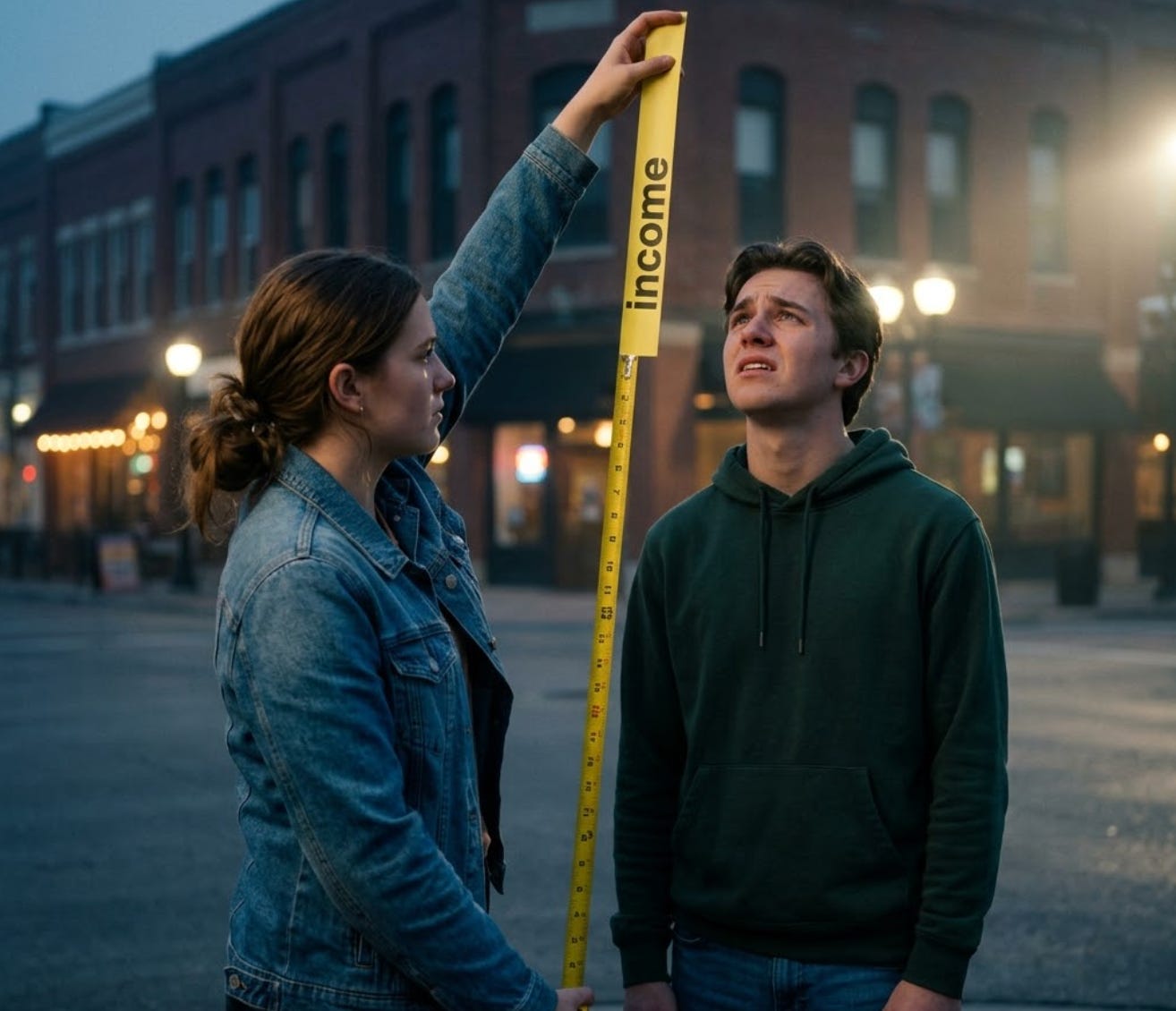
This means, however, that when the single brother goes out to date, he is competing not only against other men for a woman’s attention, but also against that woman’s rising standard for what makes a man worth marrying. These data points are circling a sad reality: the marriage threshold has risen at the same moment his ability to reach it has fallen.
The LDS-specific rungs moved too. Two generations ago, a Latter-day Saint boy was formed into a man by overlapping institutions everyone took for granted: a father who taught him the role explicitly, an Aaronic and Melchizedek Priesthood quorum that operated as a formation cohort, a Scouting program that gave him outdoor competence and Eagle Scout as a public masculine achievement, and a surrounding church culture overt about what he was being formed into and why.
Those institutions are now gone or have changed shape. The fathers stopped teaching the role explicitly — many LDS fathers in this generation are loving and faithful but were never themselves taught explicit masculine formation, and so they love their sons without forming them. The Church’s 2019 decision to leave the Boy Scouts was made for sound reasons, but Scouting did specific masculine-formation work that the new program does not replicate, and seven years later, that masculine function has not been adequately replaced. Our priesthood quorums became weekly logistics meetings instead of a brotherhood of kingdom builders.
The Joy Hidden From Sight
Let me call out the misdirect we’ve been focused on for too long. It’s a story we have been telling ourselves about why our young men aren’t pairing off. We say they prefer video games to marriage, they’re afraid of commitment, they’re addicted to porn, and they’re soft. The collapse of dating and marriage rates, the story goes, is a values failure. They stopped wanting it.
But is this true?
The most rigorous recent data does NOT support that story. The Institute for Family Studies’ April 2025 report — America’s Demoralized Men, Part 1: Worthy Aspirations, Trying Circumstances — surveyed 2,000 American men between ages 18 and 29 and found that 83% of religious young men still want to become fathers. The script has not been rejected. It has been reached for and not found. [7]
The 28-year-old returned missionary in his fourth YSA ward is not failing to want a family. He is a man whose hopes are being actively frustrated by a path that disappeared underneath him. The problematic behaviors are real — but they are symptoms of the lost path, not the cause of it.
Here is what no one put in front of our young men.
W. Bradford Wilcox — sociologist, director of the National Marriage Project at the University of Virginia, and Senior Fellow at the Institute for Family Studies — has spent twenty years measuring what marriage and fatherhood actually do to the men within them. Here is his finding, replicated across two decades of General Social Survey data:
“Fatherhood essentially pulls men out of themselves and into relationships and something far bigger than themselves.” [8]
These studies show that married fathers consistently report higher happiness than men without children. A happy marriage is the number one predictor of life satisfaction across the country. [8]
The developmental psychologist Erik Erikson taught that an adult man’s central fulfillment task is to become someone who establishes and guides the next generation. The alternative is what Erikson called self-absorption and stagnation — the slow drift into a life turned entirely inward. Fatherhood, Erikson argued, is “perhaps the most immediate, tangible way” to do that generative work. [9]
The joy of being a husband and father is the deepest fulfillment that has ever been measured and researched for adult men. And for some reason, that vision is not being consistently and doctrinally placed in front of our young men. So, while young adult men feel less needed by women and society, they don’t seem to comprehend, in a cognizant, faith-oriented way, that the path forward to joy and being needed is what they are already intuitively reaching for. They just need the path clearly repaved for them.
Solution: Cornerstone, Not Capstone
Marriage and fatherhood are not the capstone — the trophy you get after you have already become a finished man. They are the cornerstone — the orienting reality that builds the man. You become a man by living for the role, starting now, long before you walk into the temple with anyone.
Dr. Jason Carroll of the Wheatley Institute puts it directly: a young man who lives in active preparation for the role of husband and father grows into a different kind of man than one who waits passively for the role to arrive. Carroll’s punch line, from his April 2026 Marital Horizons essay published by the Institute for Family Studies, is the sentence every single brother reading this article needs taped to his bathroom mirror:
“Marriage doesn’t have to be a distant capstone waiting for them after everything else has fallen into place. Rather, it can be a developmental cornerstone that motivates, shapes, and guides their adult development.” [10]
That is the doctrine of the Family Proclamation put in the language of social science. And the doctrine itself has been on file since 1995:
“By divine design, fathers are to preside over their families in love and righteousness and are responsible to provide the necessities of life and protection for their families. Mothers are primarily responsible for the nurture of their children. In these sacred responsibilities, fathers and mothers are obligated to help one another as equal partners.” [11]
That is the role every single brother in our Church is being prepared for. Preside. Provide. Protect. Partner with a worthy woman in raising children. Each of those verbs is a different word for needed.
And the prophets and other general authorities have been showing us how to get there all along, despite the world and cultural church’s weakness.
Elder Larry M. Gibson, in his April 2015 General Conference talk “Fatherhood — Our Eternal Destiny,” gave us the single line every Aaronic Priesthood holder and every YSA brother in this Church needs to internalize:
“Fulfilling your Aaronic Priesthood duties is preparing you young men for fatherhood.” [12]
Every Aaronic Priesthood duty in Doctrine and Covenants 20 is, in seed form, the work of presiding, providing, and protecting that you will be asked to do in a home of your own. The ministering visit you are doing this week is fatherhood practice. You are not waiting for the role. You are already practicing it.
President Gordon B. Hinckley addressed our young men directly in his October 1998 General Conference talk “To the Boys and to the Men,” and even hinted back at the Family Proclamation:
“You are not ‘dead-end’ kids. You are not wasting your lives in drifting aimlessly. You have purpose. You have design.” [13]
President Boyd K. Packer drew the bright line between authority and power in his April 2010 General Conference talk “The Power of the Priesthood.” Authority is given at ordination. Power must be developed.
“You have the power of the priesthood directly from the Lord to protect your home. There will be times when all that stands as a shield between your family and the adversary’s mischief will be that power.” [14]
The single brother who is preparing rightly is literally accumulating the only thing that will eventually stand between his future family and the adversary. Every fast he keeps, every covenant he renews, every temptation he turns from — he is building the shield. The shield is built years before it is needed. The man who waits until he has a family to start building it will not have it when his family needs it.
The doctrine and the data agree on a single move: live for the role now. Don’t wait until you have it. Become it now. The cornerstone is what builds the man.
Or, in other words: MOVE FORWARD WITH FAITH. Believe in the doctrine, and trust in God as you live preparing for the most needed roles of Husband and Father.
Light On The Horizon

For the brother wondering whether any woman will ever see him — a man who is becoming this kind of man, covenant-keeping, growing in priesthood power, oriented unmistakably toward a future of presiding in love over a family, becomes the kind of man a covenant-keeping woman recognizes. Deep down, she is looking for a man she could trust to lead the home she also wants to build. When she sees that orientation in you, she will know. The Lord designed it to work this way.
Earlier in this piece, I noted that women tend to marry men whose income matches or exceeds their own. That data describes who women have historically chosen in the broader marriage market. But when researchers ask women what they actually prioritize in a long-term partner, the answer shifts.
David Buss’s foundational cross-cultural research across 37 countries found that women rank kindness above earning capacity when selecting a husband for life. [15] Among Latter-day Saints specifically, BYU Studies research on LDS courtship patterns found that single members rank spiritual confirmation as the most important criterion for recognizing the person they want to marry. [16] And Wheatley Institute research at BYU confirms the outcomes: highly religious couples report the highest levels of relationship quality, emotional closeness, and patterns of forgiveness, commitment, and kindness across every measure. [17]
The covenant orientation you are being asked to develop is the trait the right woman has been told to look for, the trait research says she actually prioritizes for life, and the trait that produces the strongest marriages in the data.
You don’t have to be polished. You don’t have to have arrived. You have to be visibly on the path toward the man the doctrine describes. The right woman is herself on that path, looking for the man who is also on it. The two of you find each other because you are both walking toward the same temple altar.
That is the doctrine. That is the data. That is perhaps the best cure for men currently.
Now here is my parting hope. That we as the cultural church do more to openly orient, train and guide the younger generations so they avoid the problems of today or greater problems of tomorrow. That we will be bolder about the doctrine, clearer about its power, and build around it for their sake and the sake of the family.
If you have been wondering whether you are actually needed — come find the brothers who already see you that way at sendmesaints.org.
The work is real. The men are real. And you are needed in it.
Sources
[1] American Institute for Boys and Men. “Richard V. Reeves Reflects on AIBM’s Growing Impact.” 2025. Read on AIBM.org
[2] Centers for Disease Control and Prevention, National Center for Health Statistics. “Changes in Suicide Rates in the United States From 2022 to 2023.” NCHS Data Brief No. 541, 2025. Read on CDC.gov
[3] Wheatley Institute, BYU Center for the Study of Elections and Democracy, and Deseret News. American Family Survey 2025. Coverage at Church News, November 23, 2025 and at Deseret News, November 14, 2025.
[4] Andersen, Christine. “Church Education Is Promoting an Endangered Species: Dating.” Deseret News, February 24, 2024. Read at Deseret.com
[5] Pew Research Center. “U.S. Women Are Outpacing Men in College Completion.” November 18, 2024. Read at PewResearch.org
[6] Wang, Wendy, and W. Bradford Wilcox. “Women Still Marry Up — But the Spousal Income Gap Is Narrowing.” Institute for Family Studies, 2024. Read at IFStudies.org
[7] Institute for Family Studies. “Young Men Are Not Checked Out — Their Hopes Are Being Frustrated.” Coverage of America’s Demoralized Men, Part 1: Worthy Aspirations, Trying Circumstances, April 2025. Read at IFStudies.org
[8] Wilcox, W. Bradford. “The Transformative Power of Fatherhood: How Being a Dad Elevates Happiness, Work, and Civil Society.” American Enterprise Institute. Read at AEI.org. See also Wilcox, W. Bradford. Get Married: Why Americans Must Defy the Elites, Forge Strong Families, and Save Civilization. Broadside Books, 2024.
[9] Erikson, Erik H. Childhood and Society. W. W. Norton & Company, 1950. (Original formulation of generativity vs. stagnation as the seventh stage of psychosocial development.)
[10] Carroll, Jason S. “Marital Horizons: The Motivating Power of Marriage for Young Men.” Institute for Family Studies and Wheatley Institute, April 2026. Read at IFStudies.org
[11] The First Presidency and Quorum of the Twelve Apostles. The Family: A Proclamation to the World. The Church of Jesus Christ of Latter-day Saints, September 23, 1995. Read on ChurchofJesusChrist.org
[12] Gibson, Larry M. “Fatherhood — Our Eternal Destiny.” April 2015 General Conference, The Church of Jesus Christ of Latter-day Saints. Read on ChurchofJesusChrist.org
[13] Hinckley, Gordon B. “To the Boys and to the Men.” October 1998 General Conference, The Church of Jesus Christ of Latter-day Saints. Read on ChurchofJesusChrist.org
[14] Packer, Boyd K. “The Power of the Priesthood.” April 2010 General Conference, The Church of Jesus Christ of Latter-day Saints. Read on ChurchofJesusChrist.org
[15] Buss, David M. “Sex Differences in Human Mate Preferences: Evolutionary Hypotheses Tested in 37 Cultures.” Behavioral and Brain Sciences, 1989. (Foundational research showing women rank kindness above earning capacity when selecting long-term partners.)
[16] Hurlbut, Jennifer, and Thomas B. Holman, et al. “Latter-day Saint Courtship Patterns.” BYU Studies Quarterly, Vol. 49, Issue 3, 2010. Read at BYU ScholarsArchive
[17] Wheatley Institute at Brigham Young University. Research on religiosity and relationship quality. Read at WheatleyInstitute.byu.edu. See also Wilcox, W. Bradford, et al. “Faith and Marriage: Better Together?” Institute for Family Studies. Read at IFStudies.org
This article is sooo dumb. It is NOT women’s responsibility to cater towards the “male loneliness epidemic” or whatever bullshit you’re coining now. Women should not be sacrificing their own life for the sake of not hurting a man’s feeling. If you’re a man feeling insecure (IN a church that CATERS towards men + is literally built patriarchally to UPLIFT MEN ONLY) then that’s YOUR problem. Go to therapy. Leave women alone until you see them as people too.